Residual Gas Potential
Evaluation of the remaining biogas production capacity and methane emissions
- Biogas and Biomethane
- Anaerobic Digestion
- AMPTS III
The residual gas potential (RGP) or residual biogas potential (RBP) test is designed to measure the stability of digestate samples under anaerobic conditions. Stability is assessed by the measurement of the total quantity of biogas produced by the digestate sample during a specified period of time, which is an indicator of its residual biodegradability.
The test involves placing the digestate, along with excess nutrients and microorganisms, in laboratory-scale reactors and measuring biogas production for a pre-defined time period (such as 28 days) at an average mesophilic (37 °C ± 1 °C) or average thermophilic temperature (55 °C ± 1 °C). When investigating the residual gas potential at reduced temperatures (psychrophilic condition), this test procedure can be carried out at room temperature, i.e., 20 °C ± 1 °C.
Determining the residual gas potential of the digestate of a biogas plant can answer the following questions: How large is the emission potential? What quantity of biogas or methane is lost after leaving the gas-tight part of the biogas plant?
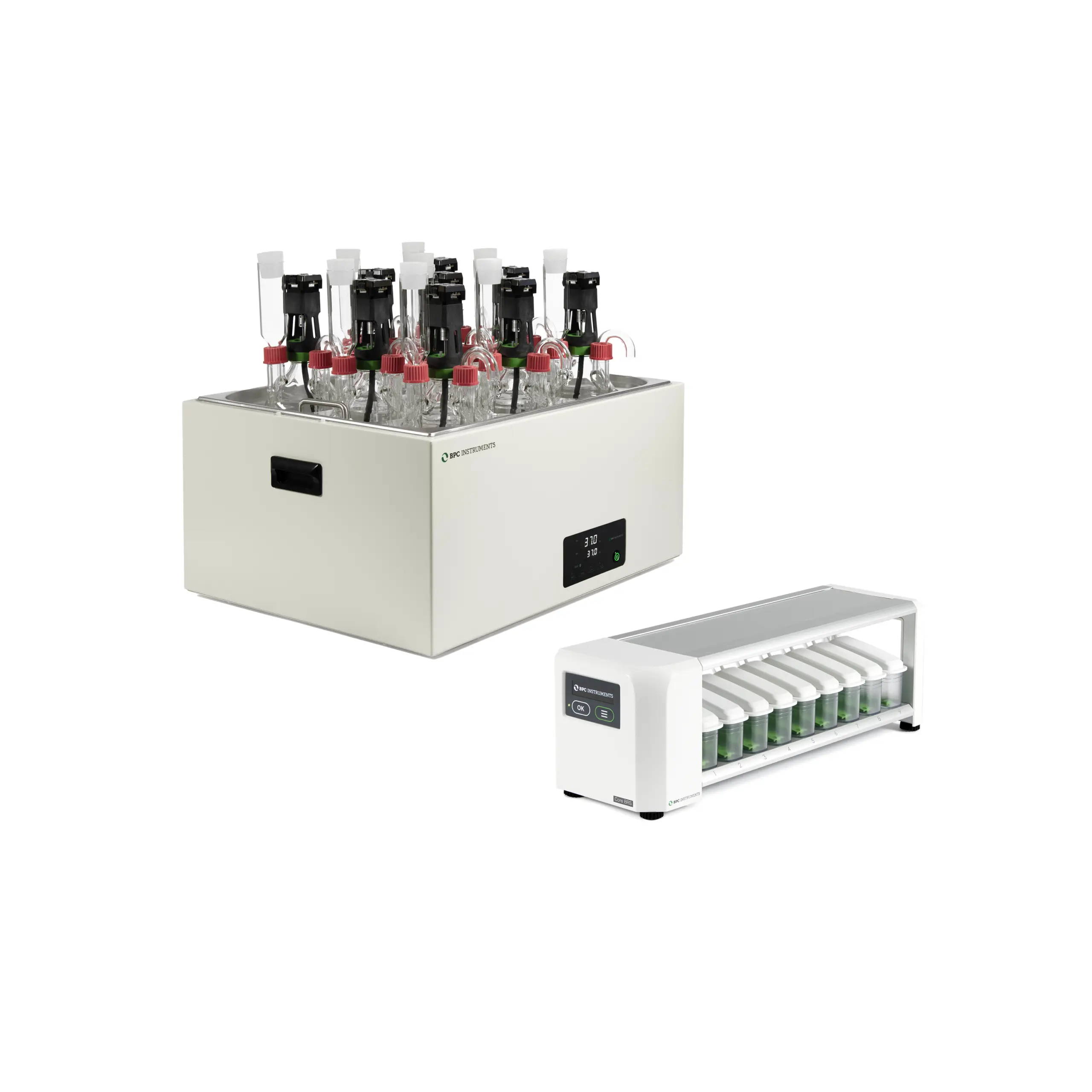
Automatic Methane Potential Test System (AMPTS) III is the research-standard analytical tool preferred by scientists and engineers for conducting various anaerobic batch fermentation tests. AMPTS is the only automated test apparatus referenced in VDI 4630 for biochemical methane potential (BMP), specific methanogenic activity (SMA) and residual gas potential (RGP).
The system consists of 18 parallel reactors (9 reactor configuration available) and the same number of gas flow meters (flow cells) attached to a detection unit for online, automatic data acquisition. This allows for the real-time investigation of a high number of feedstock samples with high precision and accuracy.

AMTPS® III
Analytical tool for biogas research and analysis
BioReactor Simulator® III
Simulate biogas production processes with minimal effort
Related scientific references
-

Synergistic valorization of crop residues and dairy wastewater via biochar-mediated anaerobic digestion enhancement
Lan, T., Wen, Y., Tong, L. Ergu, A., Zhang, L., Wu, D., Xing, A., Hong, M.Biomass and Bioenergy (2026) 212
Biomethane, WastewaterJournal article2026 -
Cellulolytic fungi from sewage sludge and their potential to improve methane fermentation
Ćwiertniewicz-Wojciechowska, C., Cema, G.,Ziembińska-Buczyńska, A.Biomass Conversion and Biorefinery (2026) 16:145
BiomethaneJournal article2026 -
Effect of harvesting interval on biogas production from Napier grass
Shah, J., Senapathy, G. J., Bisht, A., Bhagat, M. S., Rasheed, M. A.Energy, Ecology and Environment (2026), 1-15
BiomethaneJournal article2026 -
Reliable biochemical methane potential testing: insights and recommendations from global interlaboratory study
Hafner, S. D., Leca, E., Sambusiti, C., Astals, S., Azam, O., Koch, K., Liu, J., Møller, H. B., Nistor, M., Olaya-Rincon, M., Peyrelasse, C., Ward, A. J., Zennaro, B., Monlau, F. Bioresource Technology (2026) Volume 446
BiomethaneJournal article2026