OECD 301 C & 301 F (1992)
Ready biodegradability of chemical materials in aerobic aqueous medium
- Aerobic Biodegradability
- Chemicals
- Aqueous
- BPC Blue
OECD 301 (1992) test guideline presents six methods (i.e., A-F) that permit the screening of chemicals for ready biodegradability in an aerobic aqueous medium.
Method 301 C modified MITI test is based on measuring the oxygen uptake of inoculated microorganisms in well mixed suspension consisting of the test substance and mineral solution over a period of 28 days in a darkened, enclosed respirometer at 25 ± 1 oC. Biodegradation is expressed as the percentage oxygen uptake (corrected for blank uptake) of the theoretical uptake.
Method 301 F refers to manometric respirometry test. The consumption of oxygen is determined either by measuring the quantity of oxygen required to maintain constant gas volume in the respirometer flask, or from the change in volume or pressure in the apparatus.
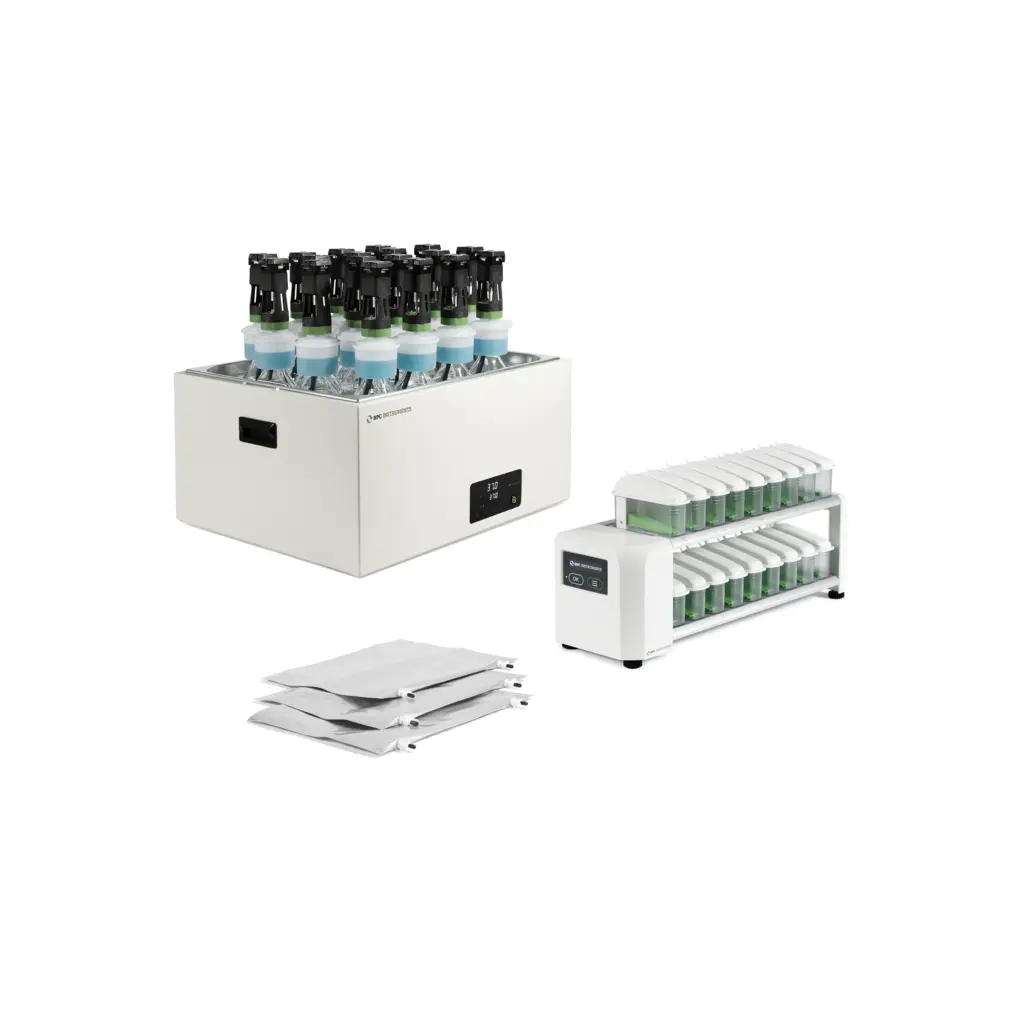
BPC Blue is a fully automated biodegradability testing system suitable for OECD 301C and 301F. Utilising an in-situ carbon dioxide absorption kit, BPC Blue functions as a closed-respirometer for continuous and on-line measurement of oxygen consumption or depletion caused by aerobic respiration of microorganisms. The instrument is suitable for all test protocols which the measurement principle is based on oxygen demand measurement.

BPC® Blue
Analytical tool for biodegradability and compostability analysis

Gas Endeavour® III
Precise measurement of gas volume and flow for diverse applications
Application Notes
Experimental conditions
Application notes for utilising OECD 301 C (1992) and OECD 301 F (1992)
Conditions
Mixing (agitation system included with BPC Blue)
Dark/diffused light (amber bottles avaliable)
Temperature
25°C (301 C, room temperature or utilising BPC Air)
22°C (301 F, room temperature or utilising BPC Air)
Method & Equipment
O2 respirometry (301 C)
O2 manometric respirometry (301 F)
Reactor Size
0.3 L (301 C)
Not specified (301 F)
Sample
Application notes for utilising OECD 301 C (1992) and OECD 301 F (1992)
Inoculum
Inoculum mix from 10 separate collection sites (301 C)
Activated sludge, sewage effluents, surface waters, soils, or a combination of these. (301 F)
Inoculum Concentration
30 mg/L suspended solids
107 – 108 cells/L
pH = 7.0 (301 C) or 7.4 (301 F)
≤ 100 mL effluent/L (301 F only)
Substrate Concentration
100 mg/L
Blank & Controls
Blank: inoculum only
Positive control e.g. mineral medium (301 C only) and e.g.,aniline, sodium acetate, sodium benzoate
Abiotic control (optional)
Toxicity control (optional, 301 F only)
Validation criteria
Application notes for utilising OECD 301 C (1992) and OECD 301 F (1992)
Replicates
3 sample and 1 blank & control (301 C)
2 sample and blank and 1 control (301 F)
Test Duration
Up to 28 days
Other Criteria
Difference of extremes of test substance < 20%
Reference compound degradation met pass level (60%) by day 14.
Biodegradation of test substance > 60%
pH within 6-8.5
Oxygen consumption of blank < 60 mg O2/L in 28 days
Biodegradation of aniline (if used) > 40% after 7 days and 65% after 14 days (301 C only)
Related scientific references
-

Changes in physical properties of growing media constituents according to biodegradation
Durand, S., Michel, J.-C.Frontiers in Horticulture (2026) 5
BiodegradabilityJournal article2026 -
Comparative Life Cycle Assessment of Algal Bioplastics and Polylactic Acid
Lin, M.-Y., Colwell, R. D., Campbell, I. R., Liao, K., Roumeli, E.ACS Sustainable Chemistry & Engineering (2026) 14:4
Biodegradability, BioplasticsJournal article2026 -
Lignin-Sourced Aromatics for Biodegradable Flexible Copolyesters Mimicking Poly(Butylene Adipate-co- Terephthalate)
Nguyen, T. T., Gonzalez, M. N. G., Engqvist, J., Wahlberg, J. Liu, G., Liu, J., Jannasch, P., Zhang, B. ChemSusChem (2025) 18
BiodegradabilityJournal article2025 -
Assessment of the biodegradability of polylactic acid (PLA) in freshwater using EN ISO 14851:2019: Challenges and outcomes
Poli, V., Lavagnolo, M. C., Basaglia, M., Bonato, T., Zanatta, S., Modesti, M.Journal of Hazardous Materials (2025) 491
BiodegradabilityJournal article2025