ISO 22404 (2019)
Aerobic biodegradation of non-floating materials exposed to marine sediment
- Aerobic Biodegradability
- Plastics
- Seawater/Marine Sediment
- BPC Blue
ISO 22404:2019 test method is a simulation under laboratory conditions of the habitat found in sandy tidal zone that, in marine science, is called eulittoral zone.
The conditions described might not always correspond to the optimum conditions for the maximum degree of biodegradation to occur. The method is based on the determination of the evolved carbon dioxide and derives from ISO 19679. The testing medium is based on a sandy marine sediment laid in the bottom of a closed flask; the sediment is kept wet with natural sea water while the test material is preferably in the form of a powder. Evolved carbon dioxide evolved from microbial degradation is determined by a suitable analytical method.
Biodegradation level is determined by comparing the amount of carbon dioxide evolved with the theoretical amount and expressed in percentage. The test result is the maximum level of biodegradation, determined from the plateau phase of the biodegradation curve.
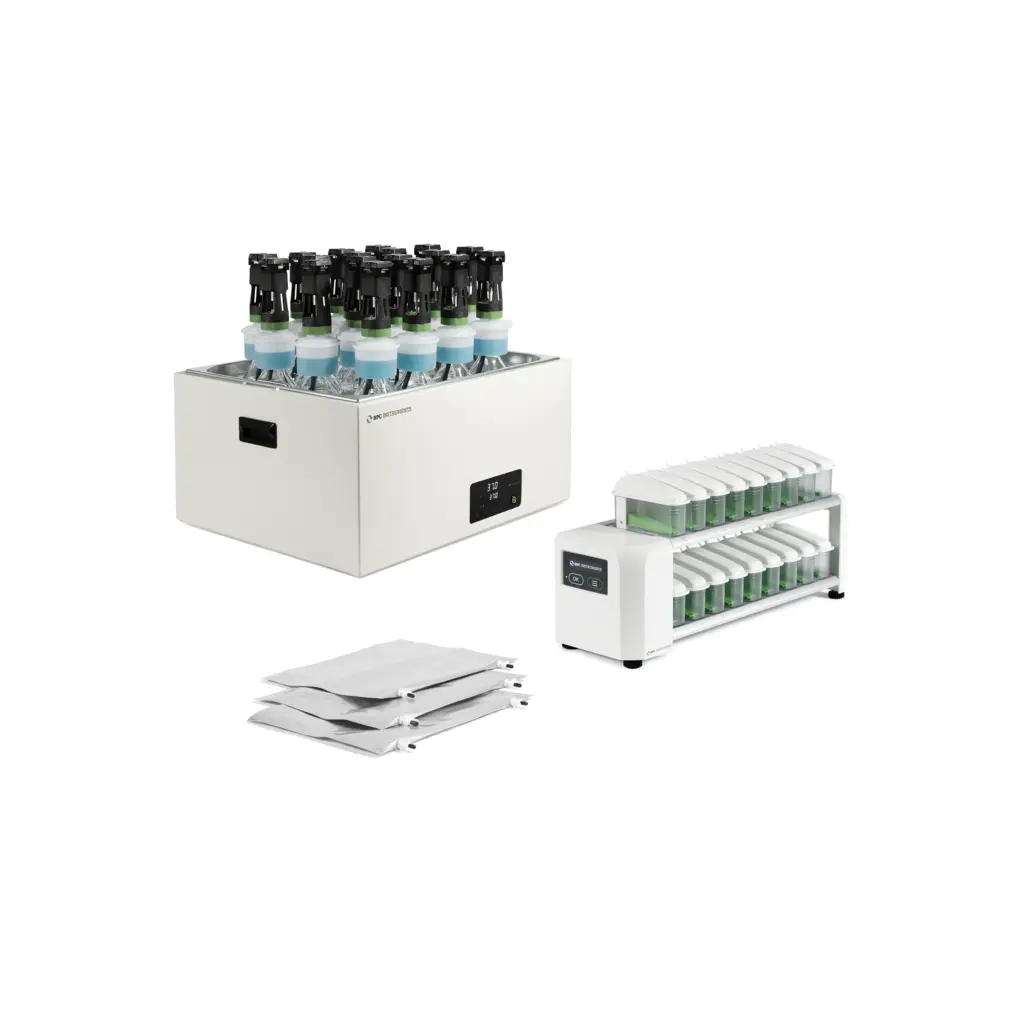
Note that the aerobic biodegradation of non-floating materials exposed to marine sediment can also be analysed according to ISO 18830:2016 based on measurement of oxygen demand (BOD). BPC Blue is a fully automated biodegradability testing system suitable for ISO 22404. Utilising an in-situ carbon dioxide absorption kit, BPC Blue functions as a closed-respirometer for continuous and on-line measurement of oxygen consumption or depletion caused by aerobic respiration of microorganisms. The instrument is suitable for all test protocols which the measurement principle is based on oxygen demand measurement.
BPC® Blue
Analytical tool for biodegradability and compostability analysis

Gas Endeavour® III
Precise measurement of gas volume and flow for diverse applications
Related scientific references
-

Changes in physical properties of growing media constituents according to biodegradation
Durand, S., Michel, J.-C.Frontiers in Horticulture (2026) 5
BiodegradabilityJournal article2026 -
Comparative Life Cycle Assessment of Algal Bioplastics and Polylactic Acid
Lin, M.-Y., Colwell, R. D., Campbell, I. R., Liao, K., Roumeli, E.ACS Sustainable Chemistry & Engineering (2026) 14:4
Biodegradability, BioplasticsJournal article2026 -
Lignin-Sourced Aromatics for Biodegradable Flexible Copolyesters Mimicking Poly(Butylene Adipate-co- Terephthalate)
Nguyen, T. T., Gonzalez, M. N. G., Engqvist, J., Wahlberg, J. Liu, G., Liu, J., Jannasch, P., Zhang, B. ChemSusChem (2025) 18
BiodegradabilityJournal article2025 -
Assessment of the biodegradability of polylactic acid (PLA) in freshwater using EN ISO 14851:2019: Challenges and outcomes
Poli, V., Lavagnolo, M. C., Basaglia, M., Bonato, T., Zanatta, S., Modesti, M.Journal of Hazardous Materials (2025) 491
BiodegradabilityJournal article2025