ISO 17556 (2019)
Aerobic biodegradability of plastic materials in soil
- Aerobic Biodegradability
- Plastics
- Soil
- BPC Blue
ISO 17556:2019 is a method for determining the ultimate aerobic biodegradability of plastic materials in soil by either measuring the oxygen demand in a closed respirometer or the amount of carbon dioxide evolved. The plastic material, which is the sole source of carbon and energy, is mixed with soil, and the mixture stands in a flask over a period of time during the which the amount of oxygen consumed (BOD) or the amount of carbon dioxide evolved is measured.
Provided that the evolved CO2 absorbed in some way, such as using an alkaline solution, the BOD can be determined by measuring the amount of oxygen required to maintain a constant gas volume in a respirometer flask, or by measuring the change in volume or pressure (or a combination of the two). Alternatively, the amount of CO2 evolved can be measured at intervals dependent on the biodegradation kinetics of the test substance by passing CO2-free air over the soil and then determining the CO2 content of the air.
The level of biodegradation, expressed as a percentage, is determined by comparing the BOD with the theoretical oxygen demand or by comparing the amount of CO2 evolved with the theoretical amount. A normal test period is six months. The test may be shortened or extended until the plateau phase is reached, but the total test period should not exceed two years.
BPC Blue is a fully automated biodegradability testing system suitable for ISO 17556. Utilising an in-situ carbon dioxide absorption kit, BPC Blue functions as a closed-respirometer for continuous and on-line measurement of oxygen consumption or depletion caused by aerobic respiration of microorganisms. The instrument is suitable for all test protocols which the measurement principle is based on oxygen demand measurement.
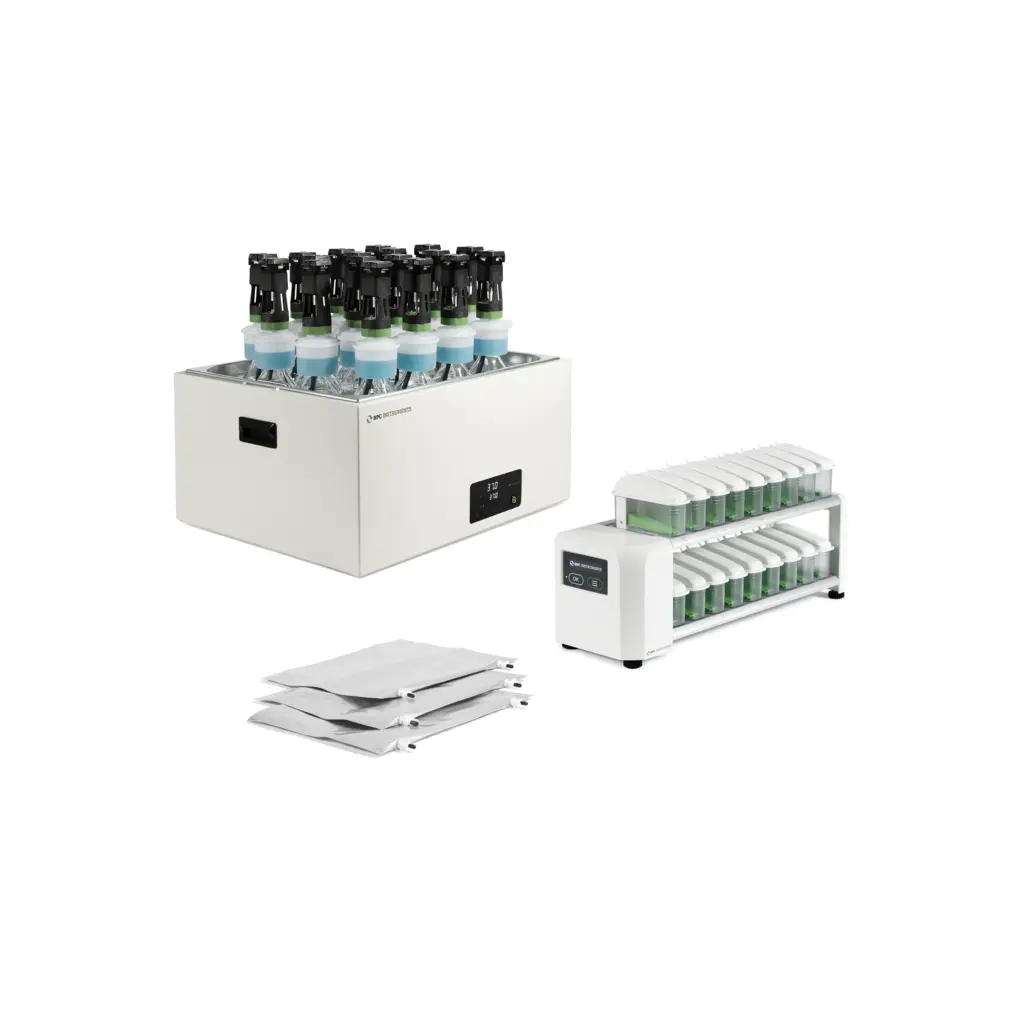
BPC® Blue
Analytical tool for biodegradability and compostability analysis

Gas Endeavour® III
Precise measurement of gas volume and flow for diverse applications
Application Notes
Experimental conditions
Application notes for utilising ISO 17556 (2019)
Conditions
Non-mixing
Dark/diffused light (amber bottles available)
Temperature
20 – 28°C (recommended 25 °C, utilising BPC Air)
Method & Equipment
Gas volume measurement, O2 or CO2 respirometry
Reactor Size
Not specified (0.5 – 2.0 L available with BPC Blue)
Sample
Application notes for utilising ISO 17556 (2019)
Inoculum
Adapted/non-adapted natural/standardised soil
Particle size < 5 mm, pH 6.0 – 8.0
Inoculum Water Content
40 – 60 % of WHC
Amount of Inoculum
100 – 300 g (wet mass)
Substrate Form
Powder < 250 um or fragments up to 0.5 x 0.5 cm (all forms supported by BPC Blue)
Amount of Substrate
O2 100-300 mg
CO2 2500 mg per 200 g
Ratio & Test Mixture
O₂: 0.1:100 g/g
CO₂: 1.25:100 g/g
C:N minimum 40:1
Blank & Controls
Blank: inoculum only
Positive control e.g. aniline, microcrystalline cellulose, ashless cellulose filler, R-PHB
Negative control (optional) e.g. PE
Inhibition control (optional)
Abiotic degredation control (optional)
Validation criteria
Application notes for utilising ISO 17556 (2019)
Replicates
3
Test Duration
6 months or until a plateau reached. Maximum 2 years.
Other Criteria
Biodegradation of positive control > 60 %
RSD of positive control < 20 %
Related scientific references
-

Changes in physical properties of growing media constituents according to biodegradation
Durand, S., Michel, J.-C.Frontiers in Horticulture (2026) 5
BiodegradabilityJournal article2026 -
Comparative Life Cycle Assessment of Algal Bioplastics and Polylactic Acid
Lin, M.-Y., Colwell, R. D., Campbell, I. R., Liao, K., Roumeli, E.ACS Sustainable Chemistry & Engineering (2026) 14:4
Biodegradability, BioplasticsJournal article2026 -
Lignin-Sourced Aromatics for Biodegradable Flexible Copolyesters Mimicking Poly(Butylene Adipate-co- Terephthalate)
Nguyen, T. T., Gonzalez, M. N. G., Engqvist, J., Wahlberg, J. Liu, G., Liu, J., Jannasch, P., Zhang, B. ChemSusChem (2025) 18
BiodegradabilityJournal article2025 -
Assessment of the biodegradability of polylactic acid (PLA) in freshwater using EN ISO 14851:2019: Challenges and outcomes
Poli, V., Lavagnolo, M. C., Basaglia, M., Bonato, T., Zanatta, S., Modesti, M.Journal of Hazardous Materials (2025) 491
BiodegradabilityJournal article2025