ISO 14855-1 (2012)
Aerobic biodegradability of plastic materials under controlled composting thermophilic conditions
- Compostability
- Plastics
- BPC Blue
ISO 14855-1:2012 test method determines the ultimate biodegradability and disintegration of test material under conditions simulating an intensive aerobic composting process.
The inoculum used consists of stabilized, mature compost derived, if possible, from composting the organic fraction of solid municipal waste. Test material is mixed with the inoculum and introduced into a composting vessel where it is intensively composted under optimum oxygen, temperature and moisture conditions for a test period not exceeding 6 months. During the aerobic biodegradation of the test material, carbon dioxide, water, mineral salts and new microbial cellular constituents (biomass) are the ultimate biodegradation products.
The evolved CO2 is continuously monitored, or measured at regular intervals, in test and blank vessels to determine the cumulative CO2 production. Percentage biodegradation is given by the ratio between the CO2 produced from the test material and the maximum theoretical amount of CO2 that can be produced from the test material, which is calculated from the measured total organic carbon content.
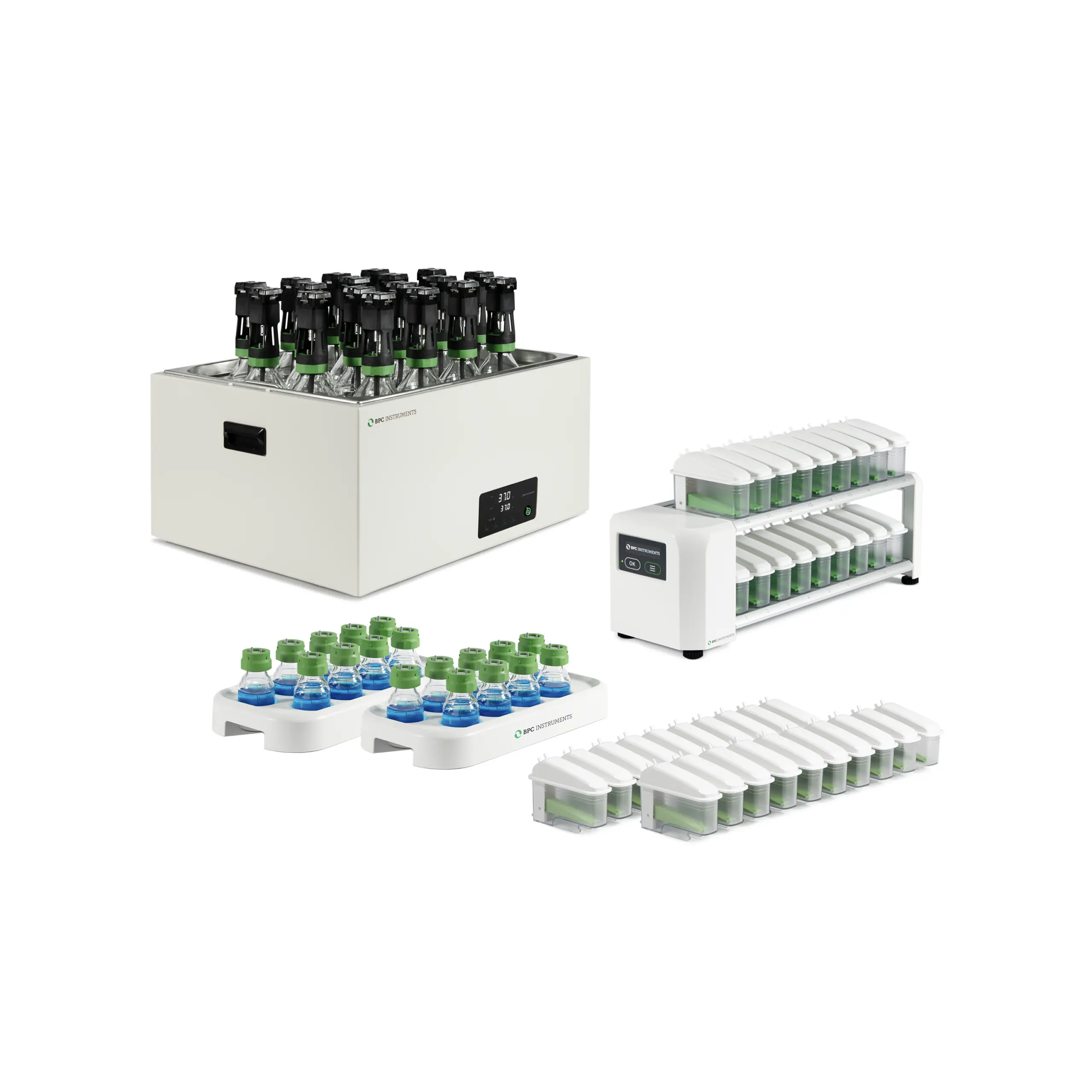
BPC Blue is a fully automated biodegradability testing system suitable for ISO 14855-1 and may be configured to evaluate aerobic biodegradability of polymer samples under the same temperature range of controlled composting conditions using industrial compost as inoculum. Utilising an in-situ carbon dioxide absorption kit, BPC Blue functions as a closed-respirometer for continuous and on-line measurement of oxygen consumption or depletion caused by aerobic respiration of microorganisms.
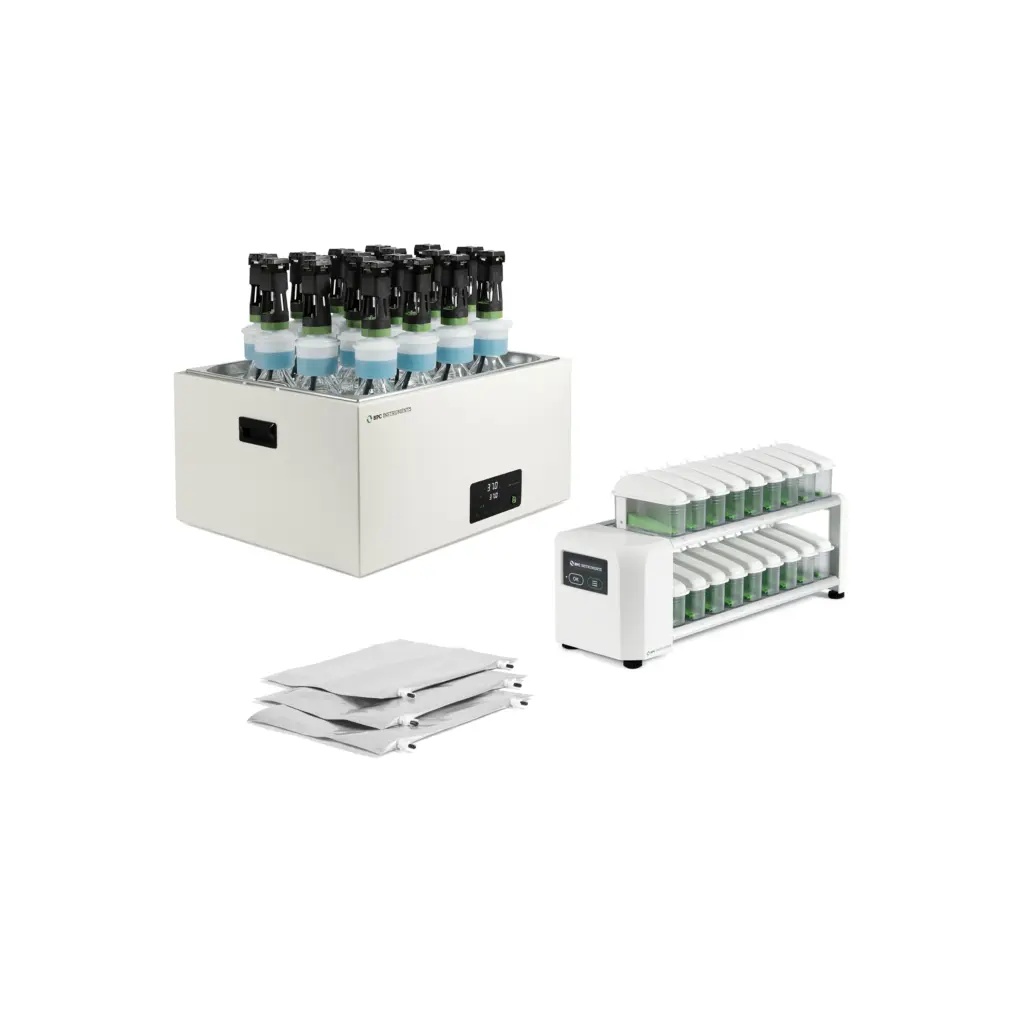
BPC® Blue
Analytical tool for biodegradability and compostability analysis
Gas Endeavour® III
Precise measurement of gas volume and flow for diverse applications
Application Notes
Experimental conditions
Application notes for utilising ISO 14855-1 (2012)
Conditions
Non-mixing
Dark/diffused light (amber bottles available)
Temperature
58 °C
Method & Equipment
Gas volume measurement, CO2
Reactor Size
≥ 2.0 L (2.0 L recommended with BPC Blue)
Sample
Application notes for utilising ISO 14855-1 (2012)
Inoculum
Mature compost from municipal solid waste
Inoculum Form
TS = 50 – 55%
pH = 7.0 – 9.0
VSwet > 15%, VSdry > 30%
Particle size 5 – 10 mm
Structural material e.g. wood, vermiculite or perlite (optional)
Amount of Inoculum
200 g TS/L
Substrate Form
Powder or fragments up to 2 x 2 cm (all forms supported by BPC Blue)
Amount of Substrate
33 g TS/L
Inoculum Substrate Ratio ISR
6:1
Blank & Controls
Blank: inoculum only
Positive control e.g. TLC grade cellulose < 20 µm
Validation criteria
Application notes for utilising ISO 14855-1 (2012)
Replicates
3
Test Duration
Until a plateau reached. Maximum 6 months.
Other Criteria
Biodegradation of positive control > 70% after 45 days
RSD of positive control < 20 %
Day 10: Blank > 50 mg < 150 mg CO2 per g VScompost
Related scientific references
-

Changes in physical properties of growing media constituents according to biodegradation
Durand, S., Michel, J.-C.Frontiers in Horticulture (2026) 5
BiodegradabilityJournal article2026 -
Comparative Life Cycle Assessment of Algal Bioplastics and Polylactic Acid
Lin, M.-Y., Colwell, R. D., Campbell, I. R., Liao, K., Roumeli, E.ACS Sustainable Chemistry & Engineering (2026) 14:4
Biodegradability, BioplasticsJournal article2026 -
Lignin-Sourced Aromatics for Biodegradable Flexible Copolyesters Mimicking Poly(Butylene Adipate-co- Terephthalate)
Nguyen, T. T., Gonzalez, M. N. G., Engqvist, J., Wahlberg, J. Liu, G., Liu, J., Jannasch, P., Zhang, B. ChemSusChem (2025) 18
BiodegradabilityJournal article2025 -
Assessment of the biodegradability of polylactic acid (PLA) in freshwater using EN ISO 14851:2019: Challenges and outcomes
Poli, V., Lavagnolo, M. C., Basaglia, M., Bonato, T., Zanatta, S., Modesti, M.Journal of Hazardous Materials (2025) 491
BiodegradabilityJournal article2025